
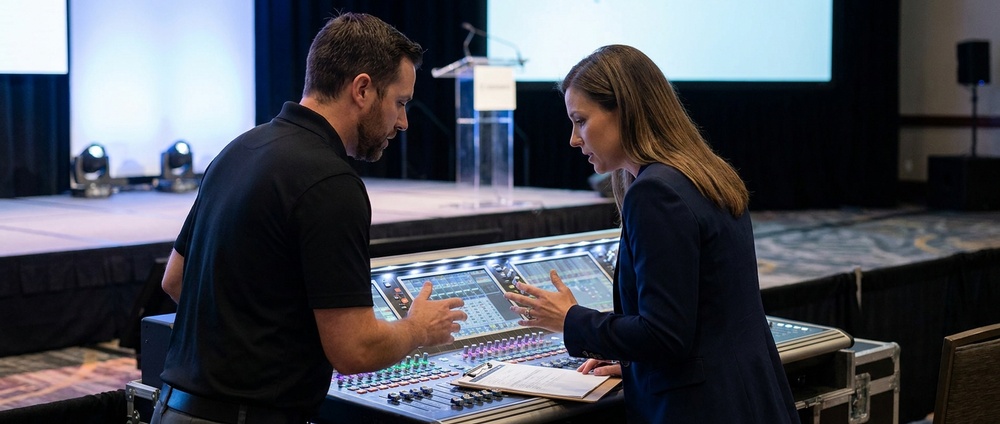
Corporate events represent a significant investment of your time, capital, and brand equity. When you gather industry leaders, internal stakeholders, or prospective clients in one room, the expectations are exceptionally high. The technical execution of your gathering dictates how your message is received by your target audience. A flawless presentation builds trust and reinforces your market authority immediately. Conversely, technical failures rapidly erode credibility and distract from your core messaging objectives. Every microphone drop or video glitch reflects poorly on your organizational standards.
Navigating the complexities of modern corporate event production requires precise planning and expert execution. You must manage a vast array of technical components to ensure a seamless experience for your attendees. Many organizations attempt to handle these logistics internally or rely solely on basic venue equipment. This approach often exposes the event to hidden vulnerabilities and catastrophic technical failures. Professional oversight is required to coordinate multiple specialized disciplines simultaneously.
Effective event technology management involves identifying and mitigating these risks long before the first attendee arrives. You need a comprehensive strategy that covers everything from staging to broadcast-quality live streaming. Professional audio visual services provide the necessary infrastructure to support your most ambitious objectives. By understanding the most common technical pitfalls, you can protect your investment and deliver a highly professional experience.
Inadequate Bandwidth and Network Planning
A stable internet connection serves as the backbone of almost every modern corporate gathering today. You rely on robust networks for live streaming, interactive audience polling, and cloud-based presentation access. Many organizers make the critical error of assuming the standard venue Wi-Fi will adequately support their needs. This assumption frequently leads to dropped streams, lagging video playback, and highly frustrated attendees. Network infrastructure is not a place to cut corners or make assumptions.
To prevent network failures, you must conduct a thorough assessment of the venue bandwidth capabilities during the initial site visit. You need to secure a dedicated, hardwired internet line specifically for your production team and streaming hardware. Relying on a shared guest network introduces unacceptable risks to your broadcast stability and overall success. Your production crew requires exclusive access to sufficient upload speeds to push high-definition video feeds to remote audiences without interruption.
Audience connectivity also requires careful logistical planning and proactive management. When hundreds of attendees connect their smartphones and laptops to a single network, the available bandwidth depletes rapidly. You should work directly with the venue IT department to establish a separate, segmented network for attendee use only. This separation ensures that guest internet traffic never interferes with your primary event technology management systems.
Implementing cellular bonding routers offers an excellent backup strategy for your primary internet connection. These specialized devices combine multiple cellular signals to create a highly stable, high-speed network. If the venue internet fails entirely, the bonding router seamlessly takes over the data load. This level of redundancy protects your corporate event production from unpredictable infrastructure outages and keeps your broadcast running smoothly.
Ignoring Acoustic Challenges in Venue Selection
The visual elements of your event mean very little if your audience cannot clearly hear the presenters on stage. Audio clarity directly impacts attendee engagement, information retention, and overall satisfaction. Many visually stunning venues feature hard surfaces like glass walls, polished concrete floors, and expansive vaulted ceilings. These architectural elements create severe acoustic reflections and highly disruptive echoing issues.
When you evaluate a potential venue, you must prioritize acoustic properties alongside aesthetic appeal. Implementing professional audio visual services involves conducting detailed sound mapping of the physical space. Audio engineers use specialized software to predict exactly how sound waves will travel and bounce throughout the room. This highly technical analysis dictates the exact placement and tuning of your speaker systems for optimal clarity.
You must avoid the temptation to rely on a venue in-house public address system for major corporate presentations. These built-in systems are typically designed for basic background music or simple, low-volume announcements. They completely lack the dynamic range and clarity required for keynote speeches or complex panel discussions. Deploying a custom distributed speaker system ensures even, pristine sound coverage across the entire audience seating area.
Proper microphone selection also plays a significant role in overcoming acoustic challenges within difficult rooms. Lavalier microphones offer visual discretion but frequently pick up unwanted ambient noise and room reflections. Directional headset microphones provide superior audio isolation for energetic speakers moving rapidly across a stage. Your audio team should strategically deploy a careful mix of microphone types based on the specific acoustic profile of the room.
Failing to Build Redundancy into Presentation Systems
Technical hardware fails without warning regardless of brand or price point. Laptops crash, cables short out, and software applications freeze at the most inconvenient moments imaginable. Operating your corporate event production with a single point of failure is a highly dangerous and unnecessary strategy. You must engineer deep redundancy into every single aspect of your presentation delivery systems.
The foundation of presentation redundancy involves utilizing multiple, precisely synchronized playback computers. You should never run a high-stakes keynote address from a single laptop sitting on a podium. Professional technicians route a primary and a secondary computer through a seamless video switcher system. If the primary machine experiences an error, the operator immediately switches to the backup feed without the audience ever noticing the transition.
File management protocols also require strict redundancy measures to prevent highly visible mistakes. Presenters frequently arrive with updated slide decks on USB drives mere minutes before they take the stage. You must establish a centralized media server to ingest, scan, and distribute these files to all playback machines simultaneously. This strict workflow prevents version control errors and ensures the correct graphics always appear on the main screen.
Power distribution represents another highly vulnerable component of your technical infrastructure. Relying entirely on standard wall outlets exposes your expensive equipment to power surges and tripped circuit breakers. You should deploy uninterruptible power supply units for all critical control equipment at the technician table. These battery backups provide enough temporary power to keep your event technology management systems running during a venue power fluctuation.
Overlooking Proper Lighting Design for Camera and Stage
Lighting serves a dual purpose in modern corporate gatherings and requires careful balancing. It must create an engaging, comfortable atmosphere for the in-person audience while simultaneously providing proper illumination for broadcast cameras. Designing a lighting plot that successfully satisfies both requirements demands highly specialized technical expertise. Standard room lighting is entirely insufficient for professional video capture and broadcast distribution.
Cameras process light entirely differently than the human eye does in a live environment. A stage that looks perfectly lit to your seated attendees may appear excessively dark, grainy, or discolored on a live stream. You must implement a strict three-point lighting strategy to visually separate your presenters from the background. This proven technique utilizes key lights, fill lights, and backlights to create visual depth and eliminate harsh shadows on the faces of your speakers.
Color temperature mismatch is a frequent and highly visible error in amateur audio visual services. Venue chandeliers or standard fluorescent fixtures often emit warm, yellow tones or cool, green hues. When mixed with professional stage lighting, this creates an unappealing, muddy color palette on camera. Your lighting technicians must carefully balance the color temperature of all fixtures to ensure natural skin tones and crisp visuals.
Dynamic lighting also plays a major role in guiding audience attention and reinforcing your corporate brand identity. You can utilize programmable LED fixtures to change the mood of the room between different educational sessions. Highlighting architectural features with custom uplighting adds a high-end, polished aesthetic to the environment. Strategic lighting design directly enhances the perceived production value of your entire corporate event.
Mismanaging the Integration of Hybrid Event Technology
Connecting remote speakers with an in-person audience introduces massive technical complexity to your operational timeline. Hybrid events require you to bridge two entirely separate operational environments in absolute real-time. Failing to integrate these systems properly results in jarring transitions, audio feedback loops, and a highly disjointed attendee experience. You must treat the virtual broadcast and the live room as two distinct productions that simply share a common schedule.
Audio routing is the absolute most challenging aspect of hybrid event technology management. When a remote speaker addresses the live room, their voice must broadcast loudly through the venue speakers. Simultaneously, the microphones in the venue must capture the live audience reactions and send that audio back to the remote speaker. If this complex routing is not perfectly configured, it creates a devastating echo that disrupts the entire presentation.
You must deploy dedicated technical directors for both the live room and the virtual stream to ensure success. A single operator cannot effectively manage the in-house video screens while also monitoring the broadcast feed and remote chat. The broadcast director requires a separate communication channel to speak privately with remote presenters before they go live. This backstage virtual green room allows technicians to verify camera framing and audio levels without disturbing the live show.
Thorough rehearsal schedules are absolutely mandatory for all hybrid events. You cannot simply turn on the cameras and expect seamless, natural interaction between physical and virtual participants. Your production team must conduct full end-to-end testing of all remote connections well before the event officially begins. This rigorous testing phase identifies latency issues and allows your team to adjust their timing cues accordingly.
Executing a flawless corporate gathering requires meticulous attention to every single technical detail. You must anticipate potential hardware failures and architect robust solutions to protect your brand reputation. Navigating complex audio visual requirements demands a highly strategic approach to logistics, equipment allocation, and personnel management. By actively addressing network stability, acoustic challenges, and system redundancy, you establish a highly secure foundation for your corporate message. Proper lighting and seamless hybrid integration further ensure that your audience remains fully engaged from start to finish.
Your organization deserves a dedicated production partner capable of managing these complex technical variables with absolute precision. Relieving the intense stress of logistical execution allows your internal team to focus entirely on content delivery and attendee networking. We provide the technical excellence and strategic oversight necessary to execute your vision flawlessly every single time. Reach out to events@breasiaproductions.com to discuss your upcoming schedule and receive a comprehensive evaluation of your production needs. Together, we can successfully build a highly reliable framework for your next major corporate initiative.